

Huawei AP661
The Huawei AP661 is a high-performance tri-band 802.11ax (Wi-Fi 6) indoor access point engineered for high-density enterprise deployments. It simultaneously operates on 2.4 GHz, 5 GHz (Radio 1), and 5 GHz (Radio 2) bands, delivering an aggregate throughput of up to 10.75 Gbps.
Designed for environments such as large conference centers, stadiums, university campuses, and enterprise open-plan offices, the AP661 uses advanced OFDMA, 8×8 MU-MIMO, and BSS coloring technologies to maximize spectral efficiency and minimize inter-cell interference — even under extreme client density.
Key highlights include:
- Tri-band concurrent: 2.4 GHz + 5 GHz Radio 1 + 5 GHz Radio 2
- Aggregate rate: up to 10.75 Gbps
- 8×8 MU-MIMO on both 5 GHz radios
- OFDMA (UL + DL), BSS coloring, Target Wake Time (TWT)
- 2× 10GE uplink ports for ultra-high backhaul capacity
- Bluetooth 5.0 BLE for IoT asset tracking and management
- Supports Fit AP (controller), Fat AP (standalone), and Cloud modes
- Compatible with Huawei iMaster NCE-Campus for intelligent management
The AP661 integrates seamlessly with Huawei's CloudCampus intelligent network architecture, supporting zero-touch provisioning, AI-driven radio optimization, and proactive fault management.
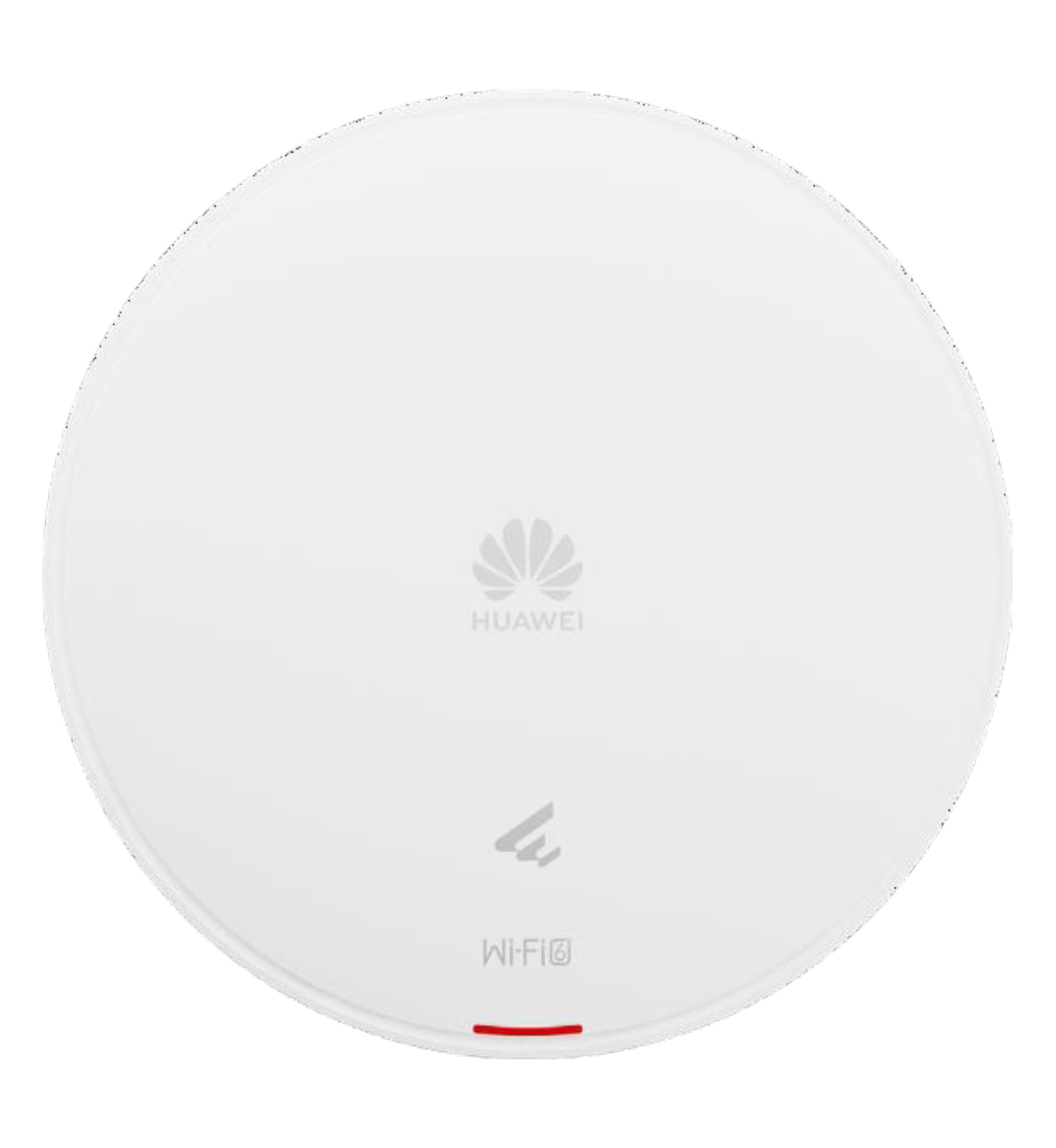
Huawei AP661 – Tri-Band Wi-Fi 6 Indoor AP
The AP661 operates three independent radio chains simultaneously — a 2.4 GHz radio (1,148 Mbps), a 5 GHz Radio 1 (4,804 Mbps), and a 5 GHz Radio 2 (4,804 Mbps) — for a combined aggregate throughput of up to 10.75 Gbps. The dual 5 GHz architecture eliminates the traditional capacity bottleneck of dual-band access points in ultra-dense environments by doubling the 5 GHz airtime available per AP.
Each 5 GHz radio integrates an 8×8 MU-MIMO smart antenna array with 3D beam-forming capability. Adaptive beam tilting dynamically focuses energy toward active clients, extending SNR at cell edges and reducing co-channel interference by up to 40% compared to legacy access points. The 2.4 GHz radio employs a 4×4 MU-MIMO array with similar beam-forming.
OFDMA divides each channel into resource units (RUs), enabling simultaneous uplink and downlink transmission to multiple clients in a single time slot — dramatically increasing effective airtime utilization in high-density scenarios. Combined with BSS coloring (spatial reuse) and CCA threshold optimization, the AP661 maintains consistent per-user throughput even at 500+ concurrent associations per AP.
Intelligent band and radio steering automatically assigns clients to the optimal radio (2.4 GHz, 5 GHz Radio 1, or 5 GHz Radio 2) based on real-time signal quality, airtime occupancy, and client capability. A dedicated background scanning radio continuously monitors the RF environment across all three bands without interrupting client traffic.
Per-client SNR, MCS index, retry rate, airtime utilization, and throughput statistics are collected at 1-second granularity. These real-time metrics feed the AI-driven radio optimization engine in iMaster NCE-Campus, enabling proactive detection of coverage holes, sticky clients, and interference sources before user experience degrades.
The AP661's multi-radio scheduler performs per-client airtime fairness across all three radios. Traffic from different SSIDs and security domains is isolated at the hardware level using per-radio VLAN segmentation, ensuring that high-bandwidth applications on one radio never starve latency-sensitive sessions on another.
A dedicated background scanning mode uses time-sliced scanning windows to perform full-spectrum RF analysis across 2.4 GHz and 5 GHz channels with minimal impact on active client sessions (less than 2% airtime overhead per scan cycle). Rogue AP detection, neighbor list generation, and interference mapping leverage this continuous background scanning capability.
Huawei's Radio Calibration (RCal) algorithm runs locally on the AP661's management CPU and coordinates with neighboring APs via the AC or cloud controller to compute globally optimal channel assignments and transmit power levels. Recalibration cycles execute automatically after detecting significant RF environment changes, such as new neighboring APs or interference sources.
The AP661 supports on-AP local authentication survivability — a locally cached authentication server continues to authenticate clients against a pre-downloaded user database even when WAN connectivity to the central RADIUS server is unavailable. This ensures uninterrupted network access for locally authenticated users during upstream failures.
Layer-7 deep packet inspection (DPI) engine identifies over 6,000 application signatures in real time at line rate. Per-application QoS policies prioritize business-critical traffic (VoIP, video conferencing, ERP) over recreational applications without requiring changes to upstream switches or routers.
The AP661 performs independent application-layer traffic classification and policy enforcement without relying on the upstream AC. In Fit AP mode, the AC pushes application classification policies; in Fat AP mode, the AP self-manages classification using its on-board signature database updated via OTA firmware packages.
Continuous WIDS/WIPS functionality detects and classifies rogue APs, rogue clients, ad-hoc networks, and man-in-the-middle attack attempts. Detected rogue devices are automatically reported to the network management system with SSID, BSSID, channel, RSSI, and first/last-seen timestamps for rapid remediation.
| Category | Parameter | Specification |
|---|---|---|
| WLAN | ||
| Standard | Wi-Fi Generation | Wi-Fi 6 (IEEE 802.11ax) — backward compatible with 802.11a/b/g/n/ac |
| Radio Bands | Tri-Band | 2.4 GHz + 5 GHz Radio 1 + 5 GHz Radio 2 (concurrent) |
| Aggregate Rate | Max Throughput | 10.75 Gbps (2.4 G: 1.147 Gbps + 5G R1: 4.804 Gbps + 5G R2: 4.804 Gbps) |
| MIMO (2.4 GHz) | Configuration | 4×4 MU-MIMO, 4 spatial streams, beam-forming |
| MIMO (5 GHz) | Configuration | 8×8 MU-MIMO per radio, 8 spatial streams, beam-forming |
| Channel Width | Supported | 20 / 40 MHz (2.4 GHz) · 20 / 40 / 80 / 160 MHz (5 GHz) |
| OFDMA | Direction | UL + DL OFDMA on all three radios |
| Modulation | Max | 1024-QAM (all radios) |
| Guard Interval | Supported | 0.8 µs / 1.6 µs / 3.2 µs (Wi-Fi 6) · 0.4 µs (802.11ac) |
| BSS Coloring | Spatial Reuse | Supported (hardware-accelerated) |
| Target Wake Time | TWT | Supported (individual + broadcast TWT) |
| Max SSIDs | Per AP | 48 total (16 per radio) |
| Max Clients | Per AP | 1024 associations (512 per 5 GHz radio, 256 on 2.4 GHz) |
| Antenna | ||
| Type | 2.4 GHz | Built-in 4×4 smart antenna, beam-forming |
| Type | 5 GHz | Built-in 8×8 smart antenna per radio, 3D beam-forming |
| Gain | 2.4 GHz | 4 dBi |
| Gain | 5 GHz | 6 dBi (per radio) |
| Max TX Power | 2.4 GHz | 27 dBm (EIRP, region-dependent) |
| Max TX Power | 5 GHz | 27 dBm per radio (EIRP, region-dependent) |
| Interfaces | ||
| Uplink Ports | ETH0 / ETH1 | 2× 100M/1G/2.5G/5G/10G Base-T (auto-negotiation; PoE-IN on ETH0) |
| USB | Type-A | 1× USB 3.0 — IoT dongle / 4G/5G failover modem |
| Console | Management | 1× RJ-45 console port (out-of-band management) |
| Bluetooth | BLE | Bluetooth 5.0 BLE (IoT gateway, asset tracking, onboarding) |
| LED | Indicator | 1× Multi-color status LED (configurable) |
| Power | ||
| PoE Input | Standard | IEEE 802.3bt (PoE++, Type 4 — 90 W max input on ETH0) |
| DC Input | Adapter | 12 V DC, 5 A (optional DC jack) |
| Power Consumption | Typical / Max | ≤ 48 W typical · ≤ 72 W maximum (full load, all radios active) |
| Security | ||
| Wireless Encryption | — | WPA3-Personal (SAE), WPA3-Enterprise (192-bit), WPA2-PSK, WPA2-Enterprise, OWE |
| Authentication | — | 802.1X (EAP-TLS / PEAP / TTLS), MAC-based, Portal (web auth), PSK, SAE |
| Mgmt Frame Protection | — | IEEE 802.11w PMF (mandatory mode supported) |
| WIDS / WIPS | — | Rogue AP/client detection, deauth flood, evil twin, ad-hoc containment |
| Network Isolation | — | Per-SSID VLAN, client isolation, Layer-2 isolation, AP-level firewall ACL |
| Management | ||
| Deployment Modes | — | Fit AP (AC-managed) · Fat AP (standalone) · Cloud (iMaster NCE-Campus) |
| Protocol | — | CAPWAP (RFC 5415 / 5416), NETCONF/YANG, SNMP v1/v2c/v3, SSH v2, HTTPS |
| VLAN | — | IEEE 802.1Q / 802.1p, per-SSID VLAN, dynamic VLAN (RADIUS attribute) |
| QoS | — | WMM (802.11e), EDCA, DiffServ (DSCP), per-user rate limiting, per-SSID shaping |
| Roaming | — | IEEE 802.11r (FT), 802.11k (RRM), 802.11v (BSS TM), OKC |
| Tunneling | — | GRE, CAPWAP data, VXLAN (cloud mode), L2TP |
| Physical | ||
| Form Factor | — | Indoor ceiling mount (circular) |
| Dimensions | Dia × H | Ø 285 mm × 58 mm |
| Weight | — | ≤ 1.65 kg (without mounting bracket) |
| Housing Color | — | Pearl White |
| Mounting | — | Ceiling plate, T-bar rail, drop-ceiling bracket (accessories) |
| Environmental | ||
| Operating Temperature | — | –10°C to +50°C |
| Storage Temperature | — | –40°C to +70°C |
| Humidity | — | 5% – 95% RH, non-condensing |
| IP Rating | — | IP40 |
| MTBF | — | > 350,000 hours |
| Parameter | 2.4 GHz Radio | 5 GHz Radio 1 | 5 GHz Radio 2 |
|---|---|---|---|
| IEEE Standard | 802.11ax/n/g/b | 802.11ax/ac/n/a | 802.11ax/ac/n/a |
| Frequency Range | 2.400–2.4835 GHz | 5.150–5.350 GHz 5.470–5.725 GHz | 5.725–5.850 GHz 5.150–5.350 GHz |
| Max PHY Rate | 1,147 Mbps | 4,804 Mbps | 4,804 Mbps |
| MIMO Streams | 4×4 (4SS) | 8×8 (8SS) | 8×8 (8SS) |
| Max Channel Width | 40 MHz | 160 MHz | 160 MHz |
| Max TX Power (EIRP) | 27 dBm | 27 dBm | 27 dBm |
| Receive Sensitivity | –96 dBm (MCS0) | –96 dBm (MCS0) | –96 dBm (MCS0) |
| Antenna Gain | 4 dBi | 6 dBi | 6 dBi |
| DFS / TPC | N/A | Yes (802.11h) | Yes (802.11h) |
| Radio | Legacy Rates | HT / VHT Rates | HE (Wi-Fi 6) Rates |
|---|---|---|---|
| 2.4 GHz | 1, 2, 5.5, 11 Mbps (802.11b) 6–54 Mbps (802.11g) |
MCS 0–7 (HT20/40) Up to 300 Mbps (2SS, 40 MHz) |
MCS 0–11 (HE20/40) Up to 1,147 Mbps (4SS, 40 MHz, 1024-QAM) |
| 5 GHz | 6–54 Mbps (802.11a) | MCS 0–9 (VHT20/40/80/160) Up to 3,466 Mbps (8SS, 80 MHz) |
MCS 0–11 (HE20/40/80/160) Up to 4,804 Mbps (8SS, 160 MHz, 1024-QAM) |
Zero-Touch Provisioning
AP661 units auto-register with iMaster NCE-Campus on first boot. Network profiles, SSIDs, VLANs, RF policies, and security settings are automatically pushed without manual CLI intervention — enabling mass deployment at scale.
AI-Driven Radio Optimization
Machine learning models analyze per-AP KPIs — coverage, interference, client distribution, and load — and proactively recommend or automatically apply optimal channel, power, and bandwidth configurations across the entire site.
Proactive Fault Management
Real-time RF monitoring with AI root-cause analysis detects anomalies (e.g., coverage holes, authentication failures, uplink degradation) and auto-generates ITSM tickets or triggers self-healing actions without manual intervention.
Application-Level Visibility
Per-user, per-SSID, and per-application traffic dashboards display real-time and historical (90-day) SLA metrics. Exportable CSV/PDF reports support capacity planning, compliance audits, and user experience optimization.
Network Slicing & Policy
Service-based policy templates define per-SSID QoS, rate limiting, access control, and security profiles. Templates can be applied globally, per-site, or per-AP group — enabling large multi-site deployments to be managed from a single pane of glass.
Seamless Firmware Management
Rolling firmware upgrades with automatic rollback ensure zero-downtime updates across entire AP fleets. Pre-upgrade validation checks verify compatibility before deployment, and version pinning is supported per AP group.
| Category | Region / Standard | Certification / Standard |
|---|---|---|
| Safety | ||
| Product Safety | Global | IEC 62368-1, UL 62368-1, EN 62368-1, CAN/CSA C22.2 No. 62368-1 |
| Laser Safety | Global | IEC 60825-1 (Class 1, not applicable for RF-only product) |
| EMC | ||
| Emissions | USA | FCC Part 15 Subpart B (Class B) |
| Emissions | Europe | EN 301 489-1, EN 301 489-17, CISPR 32 |
| Emissions | Japan | VCCI Class B |
| Immunity | Global | EN 301 489-1 / EN 301 489-17 (immunity sections) |
| Radio Certification | ||
| 2.4 GHz | USA | FCC Part 15 Subpart C (§15.247) |
| 2.4 GHz | Canada | IC RSS-247 |
| 2.4 GHz | Europe | ETSI EN 300 328 |
| 5 GHz | USA | FCC Part 15 Subpart E (§15.407) |
| 5 GHz | Canada | IC RSS-247 |
| 5 GHz | Europe | ETSI EN 301 893 |
| CE Marking | EU | Radio Equipment Directive (RED) 2014/53/EU |
| Environmental | ||
| RoHS | Europe | EU Directive 2011/65/EU + Amendment 2015/863/EU (RoHS 2) |
| WEEE | Europe | EU Directive 2012/19/EU |
| REACH | Europe | EU Regulation No 1907/2006 (REACH SVHC compliant) |
| Conflict Minerals | Global | Dodd-Frank Section 1502 compliant supply chain |
| Energy Efficiency | ||
| Power Efficiency | USA | ENERGY STAR for Network Equipment v1.0 (where applicable) |
| ErP Directive | Europe | EU Directive 2009/125/EC (Ecodesign) |
* Regulatory certifications may vary by sales region and frequency band allocation. Always verify applicable approvals with your local regulatory authority prior to installation and operation.