

AP761
The Huawei AP761 is a high-performance indoor Wi-Fi 6 (802.11ax) access point engineered for ultra-dense enterprise environments. Designed to deliver seamless connectivity with advanced multi-user throughput, it is ideal for stadiums, conference centers, hospitals, and campus deployments.
It supports dual-band concurrent operation across 2.4 GHz and 5 GHz bands, offering aggregate data rates up to 5.95 Gbps. The AP761 integrates intelligent radio resource management, beam-forming, and OFDMA technologies to maximize spectral efficiency and minimize interference.
Key highlights include:
- Wi-Fi 6 (802.11ax) compliant across 2.4 GHz and 5 GHz
- Maximum aggregate rate: 5.95 Gbps (2.4 G: 1.15 Gbps + 5 G: 4.8 Gbps)
- Built-in Bluetooth 5.0 for IoT integration
- Smart antenna technology for optimized signal distribution
- PoE / PoE+ powered for simplified cabling
- USB port for IoT accessory expansion
The AP761 works seamlessly with Huawei's CloudCampus solution and supports both fat and fit AP deployment modes, enabling flexible and scalable network architectures.
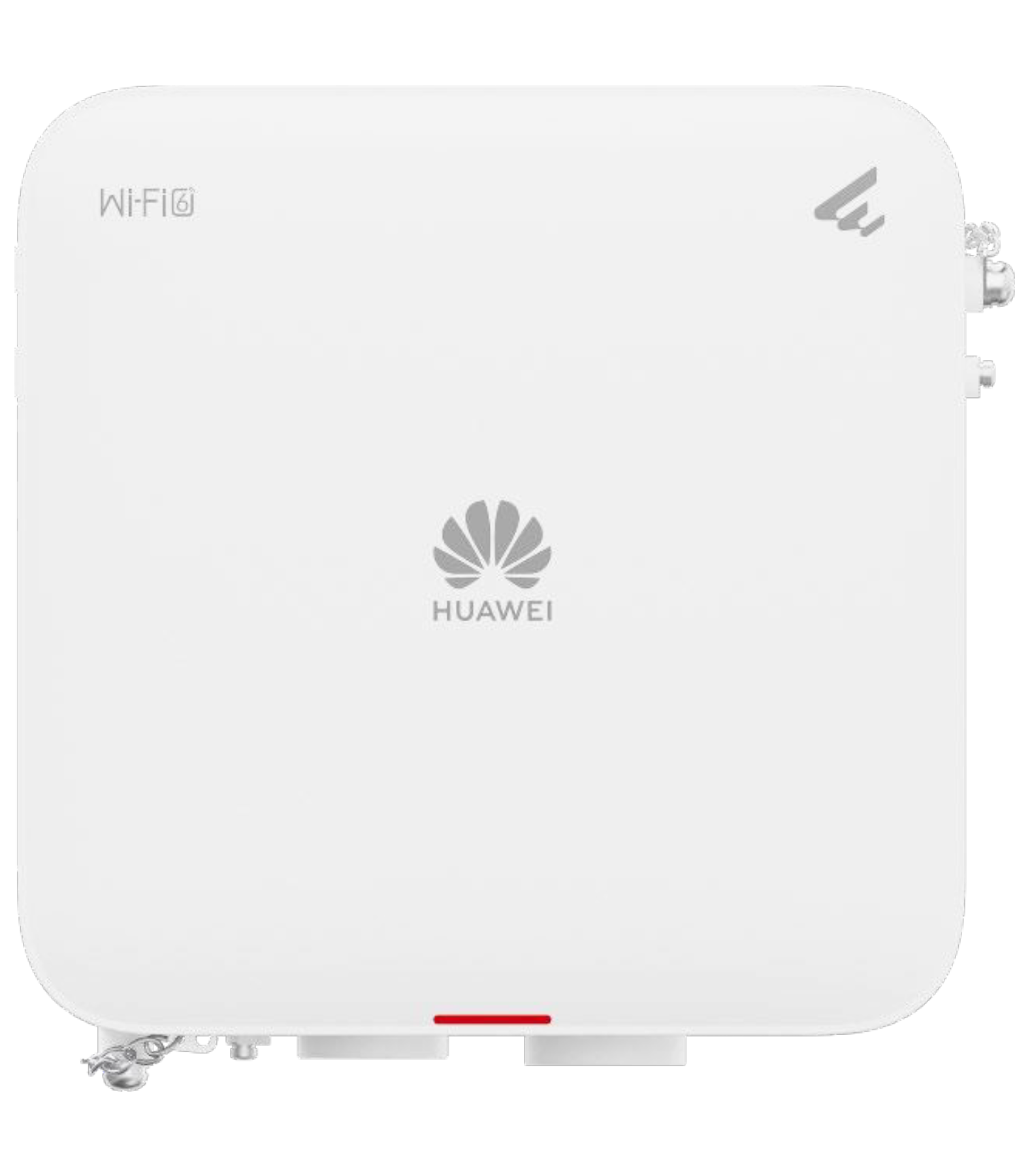
Huawei AP761 – Indoor Wi-Fi 6 Access Point
Ultra-High WiFi Throughput
The AP761 delivers a maximum aggregate rate of 5.95 Gbps over 2.4 GHz (1.15 Gbps) and 5 GHz (4.8 Gbps) bands simultaneously, supporting up to 1024 concurrent users without degradation in performance.
Antenna Technology
Equipped with an 8×8 MU-MIMO smart antenna array, the AP761 leverages 3D beam-forming and adaptive antenna tilting to ensure maximum coverage and SNR optimization across the deployment area.
High-Density Smart Optimization
Advanced OFDMA sub-channel allocation, BSS coloring, and target wake time (TWT) mechanisms dramatically reduce airtime contention in dense user scenarios, enabling consistent low-latency experience.
Smart and Reliable Security Adjustment
Integrates WPA3-Enterprise and OWE (Opportunistic Wireless Encryption) for next-generation wireless security. Enhanced PMF (Protected Management Frames) safeguards management traffic from spoofing attacks.
Intelligent Per-Path Interference Sensing
Real-time spectral scanning combined with AI-driven interference detection automatically adjusts channel selection and transmit power to deliver clean radio frequency paths at all times.
Dual-Band Noise Reduction
Hardware-level co-channel interference rejection and software-based noise floor management provide a 20 dB improvement in signal-to-noise ratio compared to previous-generation access points.
Qualifications for Joint Optimization of 5G Continuous Services
The AP761 supports seamless handoff and joint radio resource management with Huawei 5G core networks, enabling ultra-reliable low-latency connectivity for mission-critical applications in hybrid 5G/Wi-Fi 6 environments.
Analytics and On-Premises Services
Built-in analytics engine collects real-time RF metrics, user association data, and application telemetry — processed locally or streamed to Huawei iMaster NCE-Campus for centralized intelligent operations.
Guidelines and Usage for RF Architecture
Supports configurable channel bandwidth (20/40/80/160 MHz), enabling RF architects to fine-tune spectral usage for capacity-optimized or coverage-optimized deployments across different environment types.
Automatic Channel Calculation
Huawei's proprietary Radio Calibration (RCal) algorithm periodically scans neighboring APs and dynamically recalculates optimal channel assignments and power levels to minimize inter-cell interference.
Independent Application Identifier
Deep Packet Inspection (DPI) classifies over 6,000 application signatures in real time. Policy-based traffic steering, QoS marking, and bandwidth shaping are applied per application to ensure SLA compliance.
AP Management
Supports Fit AP (AC-managed), Fat AP (standalone), and Cloud-managed modes. Compatible with Huawei ACs (AC6508/AC6605) and iMaster NCE-Campus cloud controller with automated lifecycle management.
| Parameter | Specification |
|---|---|
| General | |
| Model | Huawei AP761 |
| Form Factor | Indoor Ceiling Mount / Wall Mount |
| Dimensions (H×W×D) | 220 mm × 220 mm × 56 mm |
| Weight | ≤ 1.1 kg |
| Color | Pearl White |
| Radio | |
| Wi-Fi Standard | IEEE 802.11a/b/g/n/ac/ax (Wi-Fi 6) |
| Frequency Bands | 2.4 GHz + 5 GHz (concurrent dual-band) |
| Max Data Rate (2.4 G) | 1,148 Mbps (4×4 MU-MIMO, 40 MHz) |
| Max Data Rate (5 G) | 4,804 Mbps (8×8 MU-MIMO, 80 MHz) |
| Aggregate Rate | 5.95 Gbps |
| Channel Width | 20 / 40 / 80 / 160 MHz |
| MIMO Configuration | 4×4 MU-MIMO (2.4 GHz) + 8×8 MU-MIMO (5 GHz) |
| Spatial Streams | 4SS (2.4 GHz) + 8SS (5 GHz) |
| Max TX Power | 27 dBm (adjustable per region) |
| Modulation | BPSK, QPSK, 16-QAM, 64-QAM, 256-QAM, 1024-QAM |
| Antenna | |
| Antenna Type | Built-in smart antenna |
| Antenna Gain (2.4 GHz) | 3 dBi |
| Antenna Gain (5 GHz) | 5 dBi |
| Interfaces | |
| Ethernet Ports | 2× 10/100/1000/2500 Base-T (PoE IN + PoE OUT) |
| USB | 1× USB 2.0 Type-A |
| Console | 1× Micro-USB (management) |
| Bluetooth | Bluetooth 5.0 BLE |
| Power | |
| Power Supply | PoE+ (802.3at) / PoE++ (802.3bt) |
| Power Consumption | ≤ 33 W (full load) |
| Software & Security | |
| Encryption | WPA3-Personal, WPA3-Enterprise, WPA2, OWE |
| Authentication | 802.1X, PSK, SAE, MAC address-based |
| Management Protocol | CAPWAP, NETCONF/YANG, SNMP v1/v2c/v3 |
| VLANs | IEEE 802.1Q, 802.1p, per-SSID VLAN assignment |
| QoS | WMM, EDCA, DiffServ, per-user bandwidth limiting |
| Max SSIDs | 32 (16 per band) |
| Max Concurrent Users | 512 associations (256 per radio) |
| Environmental | |
| Operating Temperature | –10°C to +50°C |
| Storage Temperature | –40°C to +70°C |
| Humidity | 5% to 95% RH (non-condensing) |
| IP Rating | IP40 |
Zero-Touch Provisioning
AP761 units auto-register with iMaster NCE-Campus upon first boot. Network profiles, SSIDs, VLANs, and RF policies are automatically pushed without manual CLI configuration.
AI-Powered Optimization
Machine learning models continuously analyze network KPIs — coverage holes, interference, client steering — and proactively recommend or auto-apply network configuration changes.
Fault Management
Real-time alerting with root-cause analysis. Integration with ITSM platforms via REST APIs enables automated trouble-ticket creation for rapid MTTR reduction.
Performance Reporting
Built-in dashboard provides per-AP, per-user, and per-application SLA reports with 90-day historical trending and exportable CSV / PDF formats.
| Region | Certification |
|---|---|
| Safety | UL/CSA 60950-1, IEC 60950-1, EN 60950-1 |
| EMC | FCC Part 15B, EN 301 489-1/17, CISPR 32 |
| Radio | FCC Part 15C/E, IC RSS-247, CE RED, ETSI EN 301 893 |
| RoHS | EU RoHS 2.0 (2011/65/EU) |
| WEEE | Compliant |