

Huawei AP371
The Huawei eXEngine AP371 is a dual-band 802.11ax (Wi-Fi 6) indoor access point designed for medium-density enterprise environments. It integrates advanced technologies such as OFDMA, MU-MIMO, and BSS coloring to deliver superior capacity and reliable connectivity.
Supporting concurrent 2.4 GHz and 5 GHz operation, the AP371 provides an aggregate data rate of up to 1.775 Gbps. Its built-in 2.5G uplink port ensures high-speed backhaul connectivity, making it ideal for offices, classrooms, hotels, and retail spaces.
Key highlights include:
- Wi-Fi 6 (802.11ax) dual-band concurrent — 2.4 GHz + 5 GHz
- Aggregate rate: up to 1.775 Gbps
- 2.5G uplink Ethernet for high-throughput backhaul
- 4×4 MU-MIMO and OFDMA on 5 GHz radio
- Bluetooth 5.0 BLE for IoT device management
- PoE+ (802.3at) powered — no separate power adapter required
- Supports Fit, Fat, and Cloud-managed deployment modes
The AP371 integrates seamlessly with Huawei iMaster NCE-Campus for zero-touch provisioning, AI-powered radio optimization, and centralized lifecycle management.
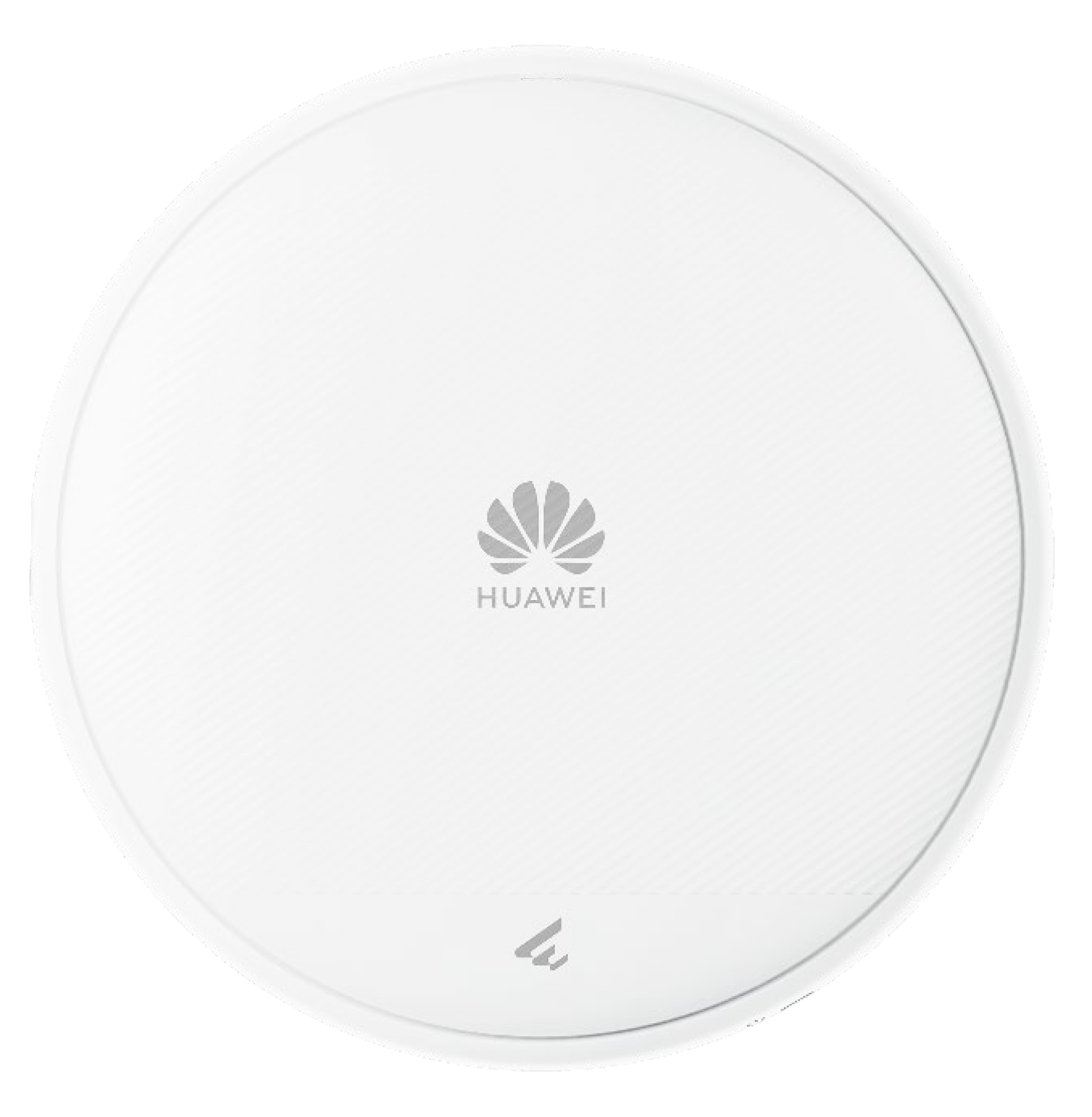
Huawei eXEngine AP371 – Indoor Wi-Fi 6 AP
Dual-Band High-Performance Radio
The AP371 operates concurrently on 2.4 GHz (574 Mbps) and 5 GHz (1,201 Mbps), delivering an aggregate throughput of 1.775 Gbps. Wi-Fi 6 technologies including 1024-QAM, OFDMA, and MU-MIMO maximize capacity in multi-user environments.
Smart Antenna System
Built-in 4×4 smart antenna array with beam-forming on both bands automatically optimizes signal patterns toward associated clients, extending effective coverage range while reducing inter-cell interference by up to 30%.
Session Management
Intelligent load balancing steers clients across 2.4 GHz and 5 GHz bands and between neighboring APs based on real-time RSSI, airtime utilization, and per-AP session counts — maximizing network efficiency without user intervention.
Dual-Band Concurrent Operation
Simultaneous 2.4 GHz and 5 GHz transmit/receive operation with independent radio chains ensures legacy device compatibility while delivering full Wi-Fi 6 performance to modern clients on either band.
Next-Generation Security
Supports WPA3-Personal (SAE), WPA3-Enterprise (192-bit security mode), and Opportunistic Wireless Encryption (OWE) for enhanced over-the-air protection. Management Frame Protection (MFP/PMF) is enforced by default.
Wi-Fi 7 Data Transmission Standards
Forward-looking firmware architecture is aligned with emerging Wi-Fi 7 (802.11be) data path standards, including multi-link operation awareness and enhanced QoS scheduling, ensuring smooth evolution of the network infrastructure.
| Parameter | 2.4 GHz | 5 GHz |
|---|---|---|
| Wi-Fi Standard | 802.11ax / n / b / g | 802.11ax / ac / n / a |
| Max PHY Rate | 574 Mbps | 1,201 Mbps |
| MIMO Streams | 2×2 MU-MIMO | 4×4 MU-MIMO |
| Channel Bandwidth | 20 / 40 MHz | 20 / 40 / 80 MHz |
| OFDMA | UL + DL | UL + DL |
| Max Modulation | 1024-QAM | 1024-QAM |
| Guard Interval | 0.8 / 1.6 / 3.2 µs | 0.8 / 1.6 / 3.2 µs |
| BSS Coloring | Yes | Yes |
| Target Wake Time | Yes | Yes |
| MCS Index | Data Rate (80 MHz, 4SS) |
|---|---|
| MCS 0 (BPSK 1/2) | 36 Mbps |
| MCS 4 (16-QAM 3/4) | 324 Mbps |
| MCS 7 (64-QAM 5/6) | 600 Mbps |
| MCS 9 (256-QAM 5/6) | 866 Mbps |
| MCS 11 (1024-QAM 5/6) | 1,201 Mbps |
Multi-Link Operation (MLO) Readiness
Firmware stack is architected to support future MLO capability, allowing simultaneous transmission and reception across 2.4 GHz and 5 GHz links for reduced latency and increased redundancy.
4096-QAM Pre-adaptation
Hardware DSP pipeline supports pre-adaptation for 4096-QAM modulation, enabling a smooth upgrade path to Wi-Fi 7 peak rates through future firmware updates without hardware replacement.
Enhanced Scheduling Engine
Redesigned MAC scheduler supports deterministic latency for time-sensitive applications (TSN-like behavior), beneficial for real-time video conferencing, VoIP, and industrial IoT workloads.
Backward Compatibility
Full backward compatibility with 802.11a/b/g/n/ac clients ensures seamless coexistence across mixed-generation device deployments with no performance penalty for Wi-Fi 6 clients.
| General | |
|---|---|
| Model | Huawei eXEngine AP371 |
| Part Number | AP371-FAT / AP371-FIT |
| Form Factor | Indoor ceiling mount / wall mount |
| Dimensions (Dia × H) | Ø 185 mm × 36 mm |
| Weight | ≤ 0.42 kg (without mounting bracket) |
| Housing Color | Pearl White |
| Mounting | Ceiling plate, T-bar ceiling rail, wall bracket (accessories) |
| Radio — 2.4 GHz | |
|---|---|
| Standard | IEEE 802.11ax / 802.11n / 802.11g / 802.11b |
| Operating Frequency | 2.400 GHz – 2.4835 GHz |
| Max PHY Data Rate | 574 Mbps |
| MIMO | 2×2 MU-MIMO (2 spatial streams) |
| Channel Width | 20 MHz / 40 MHz |
| Max TX Power | 20 dBm (EIRP, region-dependent) |
| Modulation | BPSK, QPSK, 16-QAM, 64-QAM, 256-QAM, 1024-QAM |
| Antenna Gain | 3 dBi (built-in) |
| Radio — 5 GHz | |
|---|---|
| Standard | IEEE 802.11ax / 802.11ac / 802.11n / 802.11a |
| Operating Frequency | 5.150 GHz – 5.850 GHz (country-dependent) |
| Max PHY Data Rate | 1,201 Mbps |
| MIMO | 4×4 MU-MIMO (4 spatial streams) |
| Channel Width | 20 / 40 / 80 MHz |
| Max TX Power | 23 dBm (EIRP, region-dependent) |
| Modulation | BPSK, QPSK, 16-QAM, 64-QAM, 256-QAM, 1024-QAM |
| Antenna Gain | 5 dBi (built-in) |
| DFS/TPC | Supported (IEEE 802.11h) |
| Interfaces | |
|---|---|
| Uplink Ethernet | 1× 10/100/1000/2500 Base-T (PoE-IN, auto-negotiation) |
| Downlink Ethernet | 1× 10/100/1000 Base-T (PoE-OUT, 802.3af) |
| USB | 1× USB 2.0 Type-A (for IoT dongles / 4G failover) |
| Console | 1× Micro-USB (local management) |
| Bluetooth | Bluetooth 5.0 BLE (IoT gateway function) |
| LED Indicator | 1× Multi-color system status LED |
| Reset Button | Recessed reset button (hold 5 s to factory reset) |
| Power | |
|---|---|
| PoE Standard | IEEE 802.3at (PoE+, 30 W input) |
| Power Consumption | ≤ 15.4 W (typical) / ≤ 22 W (maximum, full load) |
| PoE Budget (output) | Up to 15.4 W (802.3af) on downstream port |
| AC Adapter | Not supported (PoE only) |
| Software & Security | |
|---|---|
| Wireless Encryption | WPA3-Personal (SAE), WPA3-Enterprise, WPA2-PSK, WPA2-Enterprise, OWE |
| Auth Methods | 802.1X EAP-TLS / PEAP / TTLS, MAC-based, Portal, PSK, SAE |
| Management Frames | IEEE 802.11w PMF (mandatory mode supported) |
| Management Protocol | CAPWAP (RFC 5415), NETCONF/YANG, SNMP v1/v2c/v3, SSH v2 |
| VLAN | IEEE 802.1Q, 802.1p; per-SSID, per-user dynamic VLAN assignment |
| QoS | WMM (802.11e), EDCA, DiffServ, per-SSID rate limiting, per-user shaping |
| Max SSIDs | 32 total (16 per radio band) |
| Max Associations | 256 concurrent clients (128 per radio) |
| Roaming | IEEE 802.11r FT, 802.11k neighbor report, 802.11v BSS transition |
| Tunneling | GRE, CAPWAP data tunnel, VXLAN (Cloud mode) |
| DPI | Layer-7 application identification (> 3,000 signatures) |
| IoT Gateway | BLE 5.0 asset tracking; Zigbee / Z-Wave via USB dongle |
| Deployment Modes | Fit AP (AC-managed), Fat AP (standalone), Cloud (iMaster NCE) |
| Environmental | |
|---|---|
| Operating Temperature | –10°C to +50°C (14°F to 122°F) |
| Storage Temperature | –40°C to +70°C |
| Operating Humidity | 5% to 95% RH, non-condensing |
| IP Rating | IP31 (indoor use) |
| MTBF | > 400,000 hours |
Zero-Touch Provisioning
AP371 devices auto-discover and register with iMaster NCE-Campus upon first power-on. SSIDs, RF policies, VLANs, and security profiles are automatically applied from pre-configured network templates.
AI Radio Calibration
Huawei's RCal engine continuously monitors neighboring APs and dynamically recalculates channel assignments, transmit power, and channel bandwidth to minimize inter-cell interference and maximize user throughput.
Fault Diagnostics
Real-time monitoring with automated root-cause analysis detects RF anomalies, authentication failures, and uplink faults — triggering ITSM-integrated alerts or automated self-healing actions without manual intervention.
Analytics & Reporting
Granular per-AP, per-user, and per-application metrics with 90-day retention. Exportable SLA reports support capacity planning, troubleshooting, and compliance documentation.
| Category | Standards & Certifications |
|---|---|
| Safety | UL 60950-1, IEC 62368-1, EN 62368-1, CAN/CSA C22.2 |
| EMC | FCC Part 15 Class B, EN 301 489-1/17, CISPR 32, VCCI Class B |
| Radio Certification | FCC Part 15C/E, IC RSS-247, CE RED (ETSI EN 301 893 / EN 300 328) |
| RoHS | EU RoHS 2.0 — Directive 2011/65/EU + Amendment 2015/863 |
| WEEE | Compliant with EU Directive 2012/19/EU |
| Energy Efficiency | ENERGY STAR for Network Equipment (where applicable) |
* Actual certifications may vary by sales region. Confirm applicable regulatory approvals for your country before deployment.
Can the AP371 operate without a controller?
Yes, the Huawei AP371 supports Power over Ethernet (PoE). This allows the device to receive both power and data through a single Ethernet cable. PoE simplifies installation and reduces the need for additional power infrastructure.
Does the AP371 support mesh networking?
Yes, the Huawei AP371 is built in compliance with the Wi-Fi 7 (IEEE 802.11be) standard. It incorporates advanced wireless technologies that enhance throughput, reduce latency, and improve spectrum efficiency. This makes it suitable for next-generation enterprise networks.
What PoE switch is required?
The Huawei AP371 is designed for indoor commercial environments such as offices, healthcare facilities, and retail stores. Its dual-band architecture and smart antenna system support stable connectivity in medium-density deployments. It is well-suited for small to medium-sized business scenarios.
Is the AP371 compatible with third-party controllers?
Yes, the Huawei AP371 supports cloud-based management. Administrators can centrally configure, monitor, and maintain devices through a compatible cloud management platform. This approach helps streamline operations and reduce maintenance effort.
How fast is the AP371
The Huawei AP371 supports a combined maximum data rate of up to 3.57 Gbps across its dual-band radios. It delivers up to 689 Mbps on the 2.4 GHz band and up to 2.88 Gbps on the 5 GHz band. Actual performance may vary depending on deployment conditions and client capabilities.